There are several significant misconceptions about psychological safety.
In this article we look at the first of three common myths: That psychological safety means being nice, getting your way and having job security.
These myths can create the impression that leaders who prioritise psychological safety are too nice, let people do whatever they want and protect others’ psychological safety over holding high performance standards and expectations. This is not correct and is unhelpful!
In this article we will examine these misconceptions. In part 2 we will explore the two further myths.
Why are these misconceptions and why does it matter?
These misconceptions about psychological safety are deeply misleading in terms of its relevance for supporting the delivery of excellence in patient care.
First, let’s check the facts. The definition of psychological safety, the research base and the core findings. We will also check on similar sounding terms that are gaining attention and clarify how they are, and are not, related.
Definition: Psychological safety is a measure of team climate from the perspective of each member of the team.
It is a concept from social psychology and organisational behaviour that measures how a member of a team feels able to speak up in that team without fear of being embarrassed, humiliated or punished for doing so and for what they share (for more, see our Leadership Insight Collection).
Therefore, psychological safety in this research tradition is:
NOT the same as psychological health,
NOT the same as cultural safety or physical safety.
NOT directly related to the new WHS regulations about psychosocial risk and hazard.
What we know from the research base and its core findings is that psychological safety matters for teamwork and team performance.
Teams have the potential to deliver better outcomes than even the highest performing individual, particularly in complex and collaborative work. However, this only occurs when the team can draw on the knowledge and expertise of everyone present.
That requires high quality interactions. Listening to all contributions, asking questions, testing ideas and genuinely engaging in discussion.
Research shows that when team members experience psychological safety, they are more likely to speak up and contribute. It is this type of interaction that underpins stronger team performance, better decision making, higher engagement and greater learning, improvement and innovation.
For example, imagine a doctor in a team meeting such as an M&M, staff huddle or debrief who can say something that may be difficult to hear, controversial, unpopular or different to others without worrying about the impact on their reputation or future.
They can say, “I think we may be missing something here,” “I disagree” or “I am concerned we may have been wrong earlier.”
That contribution can open deeper discussion, surface something important and lead to change or new learning that improves patient care now and into the future.
Creating this type of climate is critical in work that relies on teamwork and collaboration to achieve the best possible outcome. Every time!
This means team members, and leaders especially, do, say and think in ways that support it.
What this looks and sounds like:
1. They make it clear that contributions are not only valued but expected.
I want you to share what you think.
I want you to tell me if I have missed something.
I want you to speak up if you see or make an error.
I want to understand your perspective.
2. They create a shared understanding that mistakes and errors while not wanted can occur - human factors research tells us this. The emphasis is on how as a team we respond to quickly correct and learn from them. They emphasise that the learning matters.
3. Finally, they show humility – they too have made mistakes! Everyone does! What matters is how we respond, learn and move forward.
How do we avoid getting caught up in these misconceptions?
Having a deeper understanding and appreciation of psychological safety and its research base helps clinicians prioritise the leadership actions and behaviours that create, strengthen and maintain it within their teams.
This also provides a clear basis to challenge the common myth we are debunking today that leaders who work to create psychological safety are too nice, too soft or allow poor performance.
Making someone feel valued and respected, and recognising that everyone has the capacity for error, is not about being soft or molly coddling.
Speaking and acting in inclusive and respectful ways is not about being politically correct. It is about creating the conditions where people can contribute.
In fact, these are strong leadership actions. They set clear expectations for how work is done. And when things are not done, or not done well, they create the environment where this can be addressed directly.
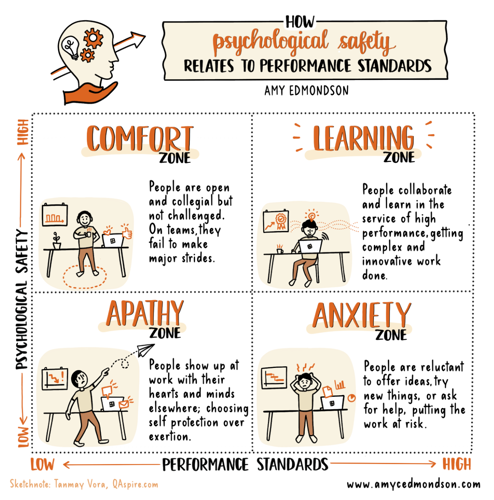
Lastly there is now also considerable research distinguishing psychological safety from performance and accountability. What this research tells us is that while they are separate dimensions, you need high levels of ‘psychological safety’ to achieve ‘high performance standards’.
See below:
Our job?
Let’s learn how to do it – to create the ‘learning zone’
Let’s do it well. Let’s do it consistently. Let’s create a healthcare team environment that is open, equal, inclusive and safe so that these teams can do the complex and collaborative work required to ensure the best patient outcomes - every time.
Resources
References
https://www.leaderfactor.com/resource-guides/the-10-outcomes-of-psychological-safety
https://hbr.org/2025/05/what-people-get-wrong-about-psychological-safety
https://www.forbes.com/sites/timothyclark/2021/06/21/what-psychological-safety-is-not/
Our Flagship Leadership Education programs feature core modules on Psychological Safety and how to create it in healthcare teams.
Leadership Education for Senior Doctors
Creating Psychological Safety in your Team
Leadership Coaching for Doctors
Explore these offerings here.
Leadership Insights are written by AMAV’s Leadership development coach and educator Dr Anna Clark (PhD) and are published fortnightly. Anna also delivers AMA Victoria’s Leadership education and Leadership coaching programs. If you would like to find out more about our leadership development offerings schedule a discovery call or email [email protected].